






























7 Tips to Stop Cats Fighting


Is your household peace regularly shattered by kitty battles, scraps, and spats? If your cats are fighting, it can be difficult to know what to do next, whether you should separate them, how to prevent another fight, and how to help them feel comfortable around each other again.
Sometimes our furry darlings just don't see nose to nose! And while it's normal for your pets to have the occasional disagreement, it's important to try to intervene in regular cat conflict to stop problems from escalating. The good news is that there are practical steps you can take to reduce conflict, manage the environment and help your cats live more peacefully together.
In this guide, we’ll explain how to stop cats from fighting, what to do if your cats are fighting, how to gradually reintroduce cats after conflict, and when you should seek advice from your vet or a qualified cat behaviourist. We all want to encourage our pets to be friends rather than foes, or at least be civil kitties – but keep in mind that some cats can want to be solitary and may never want to be sociable with other furry friends!
What To Do If Your Cats Are Fighting
If your cats are fighting, the first priority is to safely create distance between them. Avoid putting your hands between fighting cats or attempting to pick them up while they are highly agitated, as you could accidentally be injured.
Once they are separated, give both cats their own quiet space where they can calm down. This may be needed for several hours or even a day or two, depending on the cats and how they respond. Provide access to all their essential resources, including food, water, a litter tray, scratching post, and somewhere comfortable to hide or rest, so they can feel safe and settled in their space.
Don’t immediately force the cats back together. Use this time apart to identify what may have triggered the conflict and give both cats the opportunity to fully recover before deciding what to do next. If fights continue to happen, they may need to remain separated for longer before being gradually reintroduced to one another, as if they had not met before.
What To Do After a Cat Fight
1. Safely separate the cats without physically getting between them.
2. Give each cat their own space to retreat and calm down.
3. Avoid shouting at or punishing either cat, as this may increase stress.
4. Once they are calm, check for signs of injury.
5. Consider what may have triggered the conflict.
6. Make sure both cats can access their own resources without interacting with one another.
7. If fighting is repeated, severe or getting worse, speak to your vet or a qualified cat behaviourist.
Should I Let My Cats Fight It Out?
No. If your cats are involved in repeated fights or their conflicts are increasing in intensity, it's better to safely separate them rather than allowing the situation to continue. From an evolutionary perspective, cats’ ancestors were largely solitary animals, meaning cats are not naturally driven to resolve conflict in the same way that more social species - such as humans and dogs - may be. Without intervention, conflict can continue and lead to chronic stress, which can negatively impact your cats’ health and well-being.
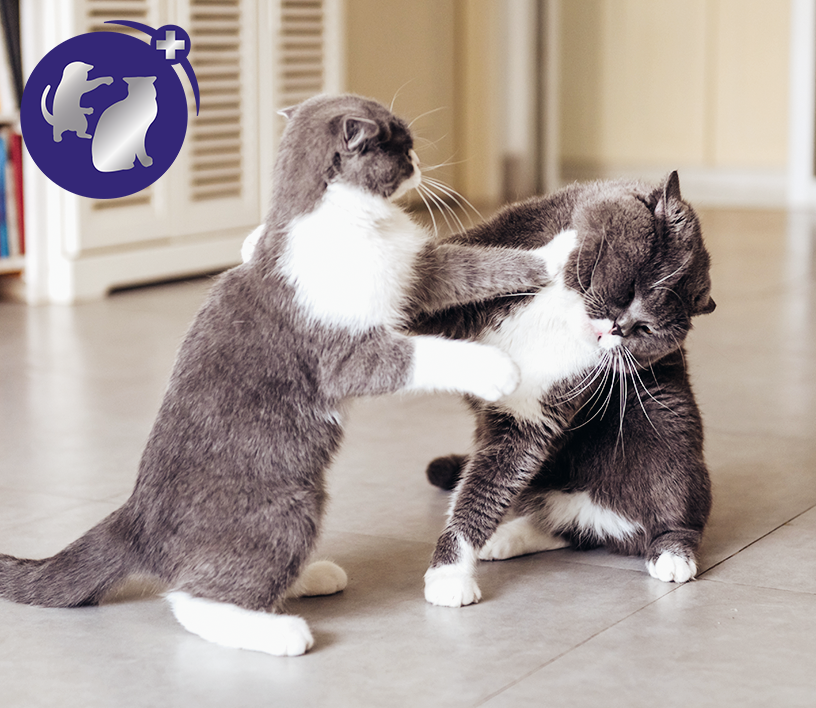
It's important to remember that not every interaction that looks like a fight is aggressive in nature. Play between cats can include chasing, pouncing, and even gentle biting. However, serious fighting is more likely to be noisy with hissing and growling and involve signs such as claws being used or one cat repeatedly chasing or pouncing on another without the interaction being mutual.
If you're unsure whether your cats are playing or fighting, look at their overall body language and whether both cats are choosing to continue the interaction.
7 Ways To Get Cats to Get Along
1. Identify Conflict Causes
The best way to get your cats to get along together, is to identify the cause. If you're not sure why your pets are in disagreement, the first thing to do is observe them and look for triggers of unwanted behaviour throughout the day:
-
Do your cats fight around food or water bowls?
-
Does conflict happen around litter trays or favourite sleeping areas?
-
Does one cat block the others access to certain rooms or resources?
-
Does fighting happen after one cat sees another animal outside?
-
Did the conflict begin after a change in the home or household routine?
-
Has a new cat recently been introduced?
-
Has one of your cats suddenly started behaving differently?
Common causes of conflict include territorial behaviour, competition for resources, environmental changes, stress, and changes in a cats health or behaviour. Identifying the trigger can help you decide which changes to make in your home.

2. Give Each Cat Their Own Space
Territory is important to cats, and sharing space can contribute to tension between cats living together. If there aren't enough spaces for each of your individual cats, you may see conflict over territory.
Give each cat opportunities to rest away from other cats. This could include:
-
Hiding places such as boxes, covered beds or cat furniture
-
Elevated resting and sleeping areas such as shelves or cat trees
Try to provide several options around the home rather than concentrating all of your cats' favourite resources in one area.
3. Increase and Separate Your Cats’ Resources
Make sure your cats have access to enough food and water bowls, litter trays, scratching posts, beds and other essential resources. Aim to have one of each resource (plus one extra) for each kitty in the house, and check that each is easily accessible.
Try to also provide several options around the home rather than concentrating all of your cats' favourite resources in one area. For example, having several litter trays next to one another may not give your cats the same choice as having them in separate areas.
Consider how your cats move around your house so you can work out the best locations for separated resources. Separation involving different levels can even be beneficial, for example placing one cat food bowl on the floor and another on an elevated surface out of sight, but in the same room when space is at a premium.
4. Reward Calm Behaviour and Provide Equal Attention
Positive experiences can help your cats feel more comfortable around each other. When your cats are relaxed in the same environment, you can reward their calm behaviour which helps them focus on being relaxed in each others’ presence.
As cats naturally prefer to be by themselves when eating, use treats as a positive experience after a successful time together, when each cat is alone. Alternative rewards for each cat when they are relaxed in each other's presence, consider using strokes around their head and cheeks.
Make sure you also spend individual time with each cat, such as playing or grooming them (depending on your cats’ individual preferences). This can help prevent competition for your attention and gives each cat an opportunity to enjoy positive interaction without another cat being involved.
The aim isn’t to force your cats to interact. Instead, give them managed opportunities to experience being around one another without conflict.
5. Reintroduce Your Cats Gradually
If your cats have been fighting repeatedly, it may help to go back to basics and reintroduce them as though they are meeting for the first time. Don't rush this process – some cats may need considerably more time than others to become comfortable.
Step 1: Separate your cats
Give each cat their own safe area with access to food, water, a litter tray, scratching post, resting areas and hiding places.
Step 2: Introduce their scents
Before allowing your cats to meet again face-to-face, allow them to become familiar with each other's scent. Swapping bedding or toys can help them gradually become accustomed to the smell of the other cat.
Step 3: Build positive associations
Use treats, food or play to create positive experiences while your cats are aware of each other's scent presence, without forcing them to interact with the source of the smell.
Step 4: Try visual contact
Once both cats are comfortable around each other’s scent, allow them to see each other while maintaining a safe distance or using a suitable barrier.
Step 5: Move to supervised interaction
When your cats remain calm around one another, gradually allow supervised interactions. Make sure both cats have an easy route to retreat if they feel uncomfortable.
Step 6: Take a step back if necessary
If either cat begins showing signs of stress or aggression, separate them and return to the previous stage rather than rushing the process. Keep in mind, it can take longer for cats to be re-introduced as they already have a previous experience with one another.
If your cats are continuing to fight, causing injury to one another, one cat is persistently hiding or avoiding the other, or either cat shows signs of stress (such as urine spraying or overgrooming), contact your vet for further advice.
6. Check With The Vet
Nobody knows your cats as well as you! So if your normally calm and peaceful pets have started to fight, it's wise to check with your vet that nothing is wrong - sometimes aggressive behaviour can be a sign that a kitty isn't feeling well! You should also seek veterinary advice if:
-
Your cats are regularly fighting or the fights are becoming more intense
-
Either cat has been injured
-
One cat is persistently hiding or avoiding the other
-
You notice changes in eating, drinking or toileting
-
Your cat's behaviour changes suddenly
-
Conflict continues despite changes to their environment and routine
Your vet can help identify whether there could be a medical cause and can advise whether additional behavioural support may be appropriate.
7. Support a Calmer Environment with FELIWAY
Creating a harmonious environment in your home should encourage your cats to act kindly towards each other. FELIWAY can form part of a wider approach to managing conflict alongside environmental changes, positive interactions and gradual reintroduction where necessary.
FELIWAY Optimum can help provide reassurance in the home and support cats experiencing stress, whether this is from conflict between cats or stressful situations such as visitors to your home. FELIWAY Optimum uses cats' natural messaging system to send a message of enhanced serenity to all cats in your household and is proven to reduce signs of tension and conflict between cats living together.
FELIWAY Friends Diffuser has also been proven to help reduce conflict between cats living together, and limit signs such as blocking, staring and chasing, bringing harmony to your cats.
What Should I Do If My Cats Keep Fighting?
If your cats continue to fight despite making changes to their environment, don't simply allow the conflict to continue. Repeated fighting can increase stress and may make it more difficult for your cats to feel comfortable around one another in the future.
Start by separating the cats and reviewing the potential causes of conflict. Make sure they have sufficient, separate resources and safe areas, and consider whether you need to restart the introduction process.
If the conflict persists, becomes more intense or results in injury, contact your vet. They can help rule out potential medical causes and advise whether you should seek support from a qualified cat behaviourist.
How to Stop Cats Fighting in Different Situations
The best way to manage conflict depends on what is causing it. Here are some common scenarios and what you can do.
My cats suddenly started fighting
If cats that normally get along suddenly start fighting, consider whether something has changed. Visitors, changes to the home, a new pet, changes in routine or stressful experiences, such as a recent vet visit or fireworks event, can all affect how cats interact.
A sudden change in behaviour can also be associated with an underlying health problem, so contact your vet if your cat is behaving unusually or showing other signs that they may be unwell.
My cats fight over food
Feed your cats separately, particularly if one cat becomes tense or aggressive around mealtimes. Make sure each cat has somewhere quiet to eat and cannot easily block another cat's access to food or water.
My cats fight when one enters a particular room
Consider whether the room contains an important resource, such as food, a litter tray or a favourite resting place. Increasing the number of resources and providing alternative spaces may reduce perceived competition. It can help to provide hiding or elevated spaces in rooms, so cats can manage getting through rooms without having to physically pass another cat.
My cats fight after seeing cats outside
An unfamiliar cat outside the home can sometimes become a source of tension. If you notice conflict after your cats see another cat through a window, consider reducing their access to that visual trigger such as using window film, and provide alternative places for them to rest.
My new cat and resident cat keep fighting
Don't force them to spend time together. Separate them and restart the introduction process gradually, beginning with scent before progressing to visual contact and eventually supervised interaction. If your cats continue to fight, seek professional advice.
To see more read our article on tips to help cats get along.
Lastly, whatever solutions you choose, be sure to give your kitties time! It may take a while for your cats to respond, and change their catty attitudes!

Frequently Asked Questions About Cats Fighting
How do I stop cats from fighting?
To help stop cats from fighting, first identify what is causing the conflict and make sure each cat has enough separate resources and places to retreat. If a fight occurs, safely separate the cats and allow them to calm down before gradually rebuilding positive interactions. If fighting continues, seek advice from your vet or a qualified cat behaviourist.
How do I stop my cat attacking my other cat?
Safely separate your cats and look for potential triggers such as competition over resources, territory, environmental changes or stress. If the behaviour continues, a gradual reintroduction may help rebuild their relationship. Also make sure to arrange a health check in this situation in the case that your cats are injured.
How can I calm my fighting cats?
The first priority is to safely separate the cats and give them time to calm down in their own safe space along with all their own necessary resources, including FELIWAY Optimum.
When should I seek help for cats that fight?
Contact your vet if fighting is frequent, severe, results in injury, starts suddenly or is accompanied by other changes in behaviour, as they will be able to rule out any medical issues which could be involved. It then is recommended to seek help from a qualified animal behaviourist to provide tailored support for the relationships between the cats in your home.
For more helpful tips on cat behaviour, take a look at our blog. And don’t forget to sign up to the Feliway newsletter to be kept up to date on the latest news, research, and product releases.